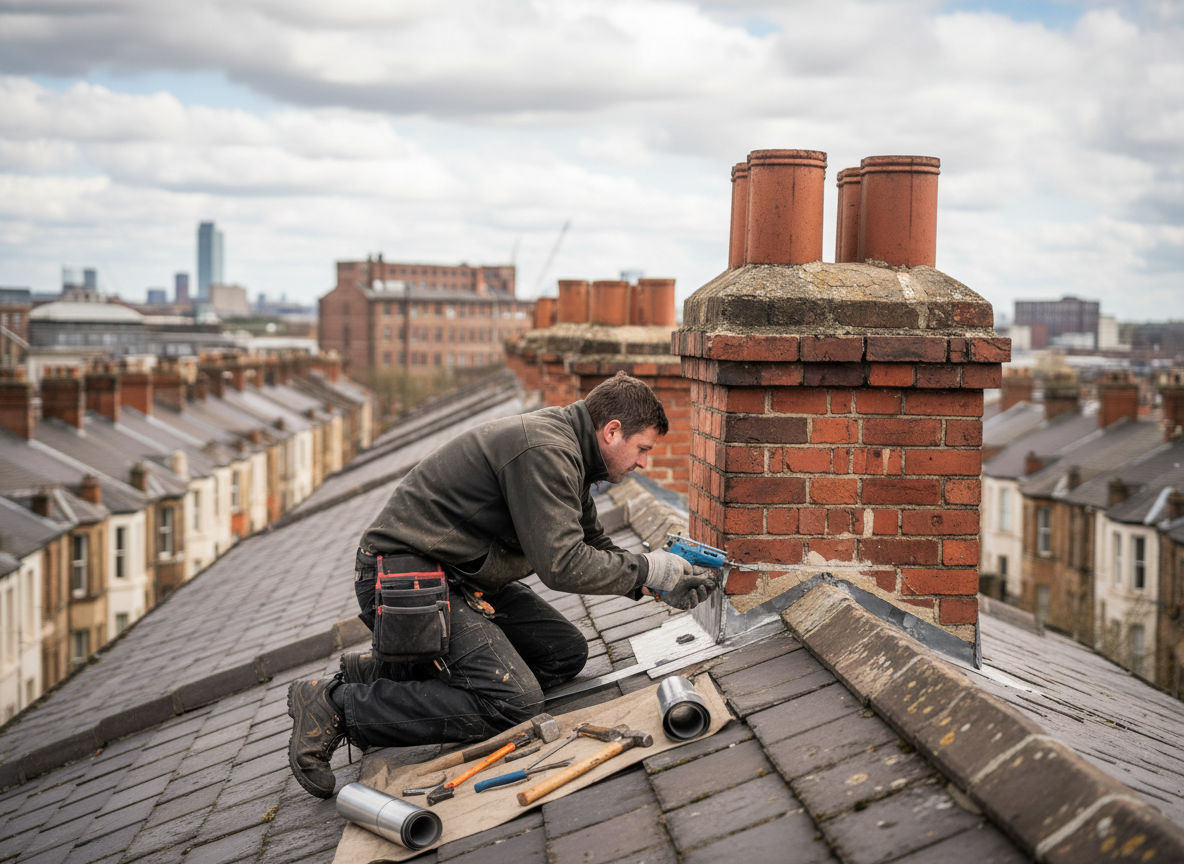
Chimney flashing fails when step flashing lifts or counter flashing pulls away from the masonry, letting water run behind the brick and into the attic. In Manchester homes built from the 1970s onward, the most common issue is corrosion on galvanized step flashing combined with wind-driven rain from coastal storms that forces water under the metal. Proper repair requires removing the first course of shingles, installing new copper or stainless step flashing, and re-sealing the counter flashing into a clean reglet cut in the chimney mortar. Skipping the reglet cut is the fastest way to create a repeat leak within two seasons.
Roof pitch, chimney location, and cricket presence all change the scope of work. Flashing on a chimney set mid-roof needs a cricket to shed water; many Manchester properties lack one because the original builder omitted it. Adding the cricket during repair prevents ice damming and leaf accumulation that traps moisture against the flashing. Access is another local factor: single-story ranch homes common in the area allow ladder work from the ground, while two-story homes require roof jacks and fall protection that adds time.
We always inspect the crown and flue liner while on site because water entering through failed flashing often travels down the flue and damages the smoke chamber. Replacing only the flashing without checking the crown leaves the homeowner with a hidden leak path that shows up months later as stained ceilings.
All work follows Ocean County building practices for wind uplift and uses corrosion-resistant fasteners rated for coastal exposure. Homeowners receive a written description of every piece of metal replaced and photos of the reglet cut before we leave.
Technician insight
In Manchester, the thing that catches most people out with chimney flashing repair is how nor'easters drive rain sideways under the step flashing on the many 1970s ranch homes in Leisure Village and Pine Lake Park where the original galvanized metal has already thinned from salt air.
Mid-roof chimney leak after nor'easter
Water stains appeared on the living-room ceiling after a coastal storm. Inspection showed lifted step flashing on the north side of the chimney with no cricket present. We removed the first three courses of shingles, installed new copper step flashing, added a cricket, and recut the reglet for the counter flashing. The homeowner reported no further leaks through the next winter.
How it works
- 1
Site Assessment
We examine the flashing from the roof and attic, check for water stains on rafters, and note roof pitch and chimney location.
- 2
Material Removal
Shingles are lifted carefully, old flashing is removed, and the reglet is cleaned or recut to accept new counter flashing.
- 3
New Flashing Installation
Copper or stainless step flashing is woven into the shingles, a cricket is added if missing, and counter flashing is set in the reglet with compatible sealant.
- 4
Final Check and Documentation
We verify the seal from inside the attic, photograph the completed work, and provide the homeowner with a written summary.
Pricing
Cost depends on roof height, number of sides requiring repair, and whether a cricket must be added.