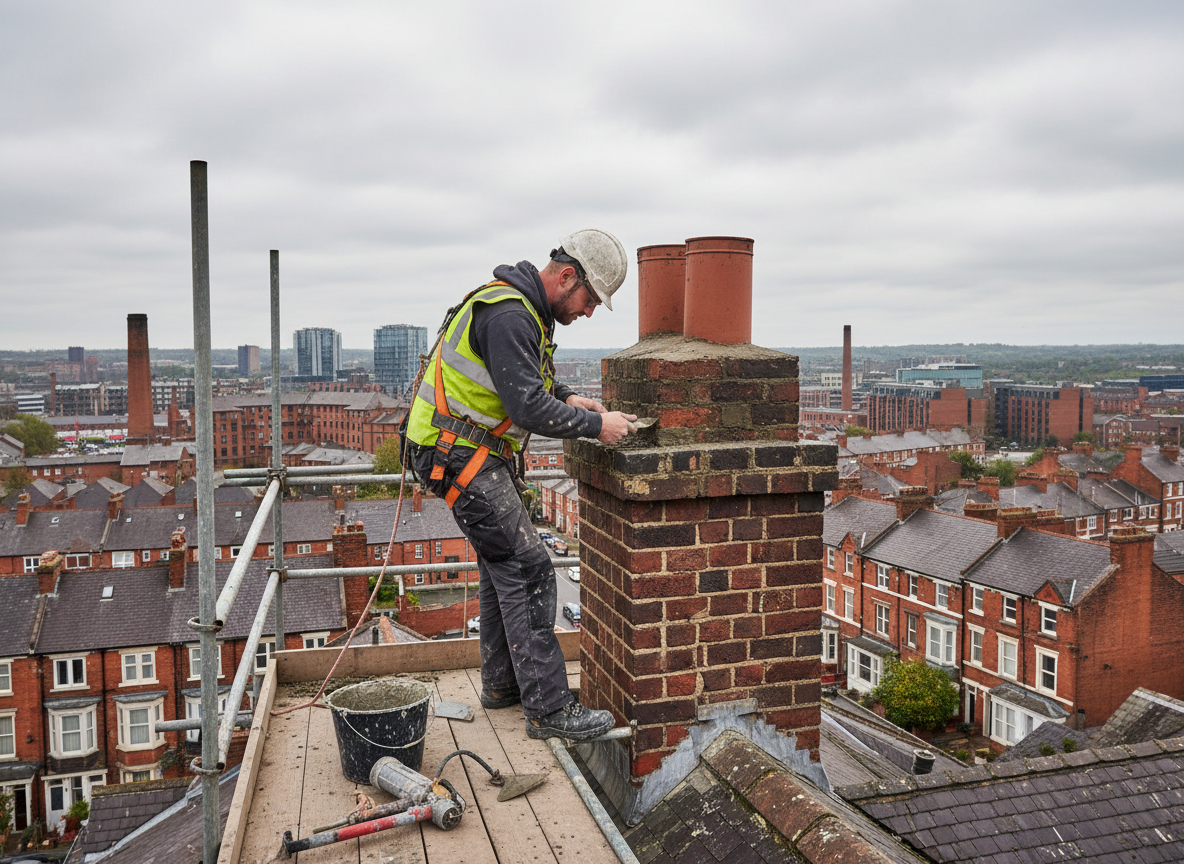
Chimney mortar in Manchester homes often fails where lime-based joints meet modern cement patches. Older brick stacks built before the 1970s expand and contract differently, causing hairline cracks that let water reach flue tiles. We rake out only the failed mortar to sound material, then tuck-point with a type N or O mix matched to the original bedding. This prevents the wider cracking that forces full flue liner replacement later.
Manchester’s winter freeze-thaw cycles and summer humidity accelerate spalling on south-facing chimneys. Rain driven by nor’easters soaks through open joints and freezes overnight, pushing bricks outward. We inspect for hidden voids behind the face brick and install weep holes where needed so trapped moisture can escape instead of pushing new mortar off the wall.
Common Edge Cases in Manchester Chimney Mortar Repair
Homeowners often confuse surface cracks with full joint failure. We probe each joint with a knife before deciding whether to repoint or rebuild. When crown flashing is missing, we add a new concrete cap sloped to shed water before the mortar work begins.
Seasonal Timing Considerations
Scheduling repointing between late spring and early fall gives the new mortar time to cure before the first hard freeze. Winter repairs require cold-weather additives and tenting, which raises labor time on two-story stacks common along Manchester’s side streets.
Technician insight
In Manchester, the thing that catches most people out with chimney mortar repair is the hidden void behind the face brick on homes built in the 1960s. Freeze-thaw cycles here open joints that look solid from the ground, so we always probe before quoting. Skipping that step means the new mortar fails within two winters.
Hidden Void Behind Face Brick
A Manchester homeowner noticed white staining inside the attic after a heavy rain. We found open joints on the north stack and probed to discover a 4-inch void where the original mortar had washed out. We raked the full height, packed new mortar, and added weep holes. No further water reached the attic after the next nor’easter.
How it works
- 1
Site Assessment
We examine every joint from crown to roof line, noting loose bricks, vegetation, and water staining on interior walls.
- 2
Joint Removal
Failed mortar is cut out to a minimum ¾-inch depth without damaging surrounding brick faces.
- 3
Mortar Matching and Installation
A compatible lime or cement-lime mix is prepared and packed in layers, tooled to match the original profile.
- 4
Curing and Final Check
The work is kept damp for three days, then inspected for shrinkage cracks before the job is signed off.
Pricing
Pricing is quoted after on-site inspection because joint depth, access height, and extent of hidden damage vary widely on Manchester chimneys.